Showing posts with label metroidvania. Show all posts

Wednesday, November 30, 2016

Witch cards will drop: Ittle Dew

If you look at my Steam game playing history in terms of hours spent, I tend to gravitate toward somewhat less action-y, somewhat more think-y games but rarely all that think-y. I'm not a puzzle guy, not really, I lack patience. I always have. I do like turn based 4x games; the reason I haven't reviewed many (or any, I'd have to check) ends up with the feeling they eat time like no other. It's kinda hard to write about a game you should probably put a good hundred hours into to get a real feel for what it's like.

I do like puzzles in some games, though. I remember the sci-fi grounded puzzles in Dead Space really fondly. Clearing jams in the artificial gravity unit or life support wings were cool, generally unique ideas. But puzzle games themselves are generally the same thing repeated over and over. Push a block. Push a block. Now, push a block.

Generally, I think the biggest issue is one of general pacing - puzzle games tend to be sluggish and mistake the deliberate pace of the puzzle gameplay with something the game should have at all points in the production. It often feels like half the challenge is not getting bored out by having to slowly shove blocks around a room while your character moves at the speed of a waterborne slug.

Ittle Dew is a block pushing puzzle game. It was done by, previous to, the same individual(s) who put out Card City Nights, which was a pretty fun single player card game. It has the same tongue in cheek sense of humor and shares the same basic art style, albeit in a somewhat different setting than whatever you want to say CCN was in.

Friday, January 1, 2016

Over the verge; Axiom Verge

Axiom Verge is the product of a single dude, which has long since lost real meaning to me. Thomas Happ be his name, and he made a game about ... Whatever this game is actually about is somewhat hard to describe. I'm going to try to describe the game without spoiling the game, which is actually much more difficult than you'd think, because certain explicit and implicit elements of the gameworld are tampered with as a matter of due course for the story to unveil and then unfold.

At its core, before anything else is layered on, Axiom Verge is a Metroid leaning Metroidvania. There are a lot of reviews and a lot of commentary built from that central point, and a lot of it goes from there to become very hostile and negative. Oh how dare a single gentlemen lovingly craft a passion project in his side hours that builds from his experiences in retro-gaming of the Nintendo-kind! How dare he infringe on that holy space!

Thing is, as I said back in the Super cyborg review, I honestly don't care anymore. We're not in the early generations of gaming here, and the fact that someone who was raised on video games made a video game that feels like video games is like complaining that a major book series feels like a book within its genre. Yeah, it is a Metroidvania that feels like a Metroidvania.

Get over it. The genre is actually pretty narrow, if you actually want it to feel like Metroid, and not something like Strider where the Metroidvania elements feel like a contagion that infected an action game's genome and dragged the entire production down.

To me the real question is whether or not Axiom Verge, in and of itself, by itself, feels like a quality and polished product that I enjoyed playing, and/or, think others should play.

Thursday, December 31, 2015

Toward the Verge: Strider

Strider!

Strider is a word used here for ... Like literally ninja. You're a "strider" from a "strider" school which teaches you to strider people to death. It's weird. They also call you "Strider" like it's a name but you are also a strider from that strider school, and they previously sent other striders to bestride the stride-able but they failed in their striding leaving all possible stridering to you.

Or something? In Ninja Gaiden do they just call the main character 'ninja?'

I had actually played Strider on the Genesis slash Mega Drive back when I was a young'un, but I don't have any strong memories of it. Reading wikipedia on the history of the release, it sounds like it was considered very highly as games go and not a metroidvania at all. Strider, here, is a Metroidvania and thereby covered vaguely under the toward the verge sub-banner of games I've played.

I'm going to be honest in that as a genre goes or has gone for me this year, this has not been what I would call a pleasant set of games. Generally speaking what you end up with are a lot of games with dull hallways, mediocre enemy placement, boring gameplay. No sense of exploration, of 'opening up' the game world or progression.

Strider is both the best and worst of the games I played in this regard. I didn't write many reviews, since there are more than a few games I feel like I might go back to in the doldrums between the two great sales, when I'm not trying to grind out many a card. Strider is a mix of a lot of elements that really make me wonder how much better it would have been if it wasn't crippled by being lashed to metroidvania elements.

It is also apparently inspired by Shadow Complex, so man, did that ever make me not want to pick up Shadow Complex.

The coolest thing about this game is that the Strider's scarf changes color when you change plasma options. You won't notice this early on, since you don't get a plasma change for quite a while, but you can actually change it on the fly and it slowly flows out. A lot of the visuals pick up on this sort of subtle element while the rest of the game hesitantly sits down before drooling on itself.


Tuesday, December 8, 2015

It is also about robots: Steamworld Dig

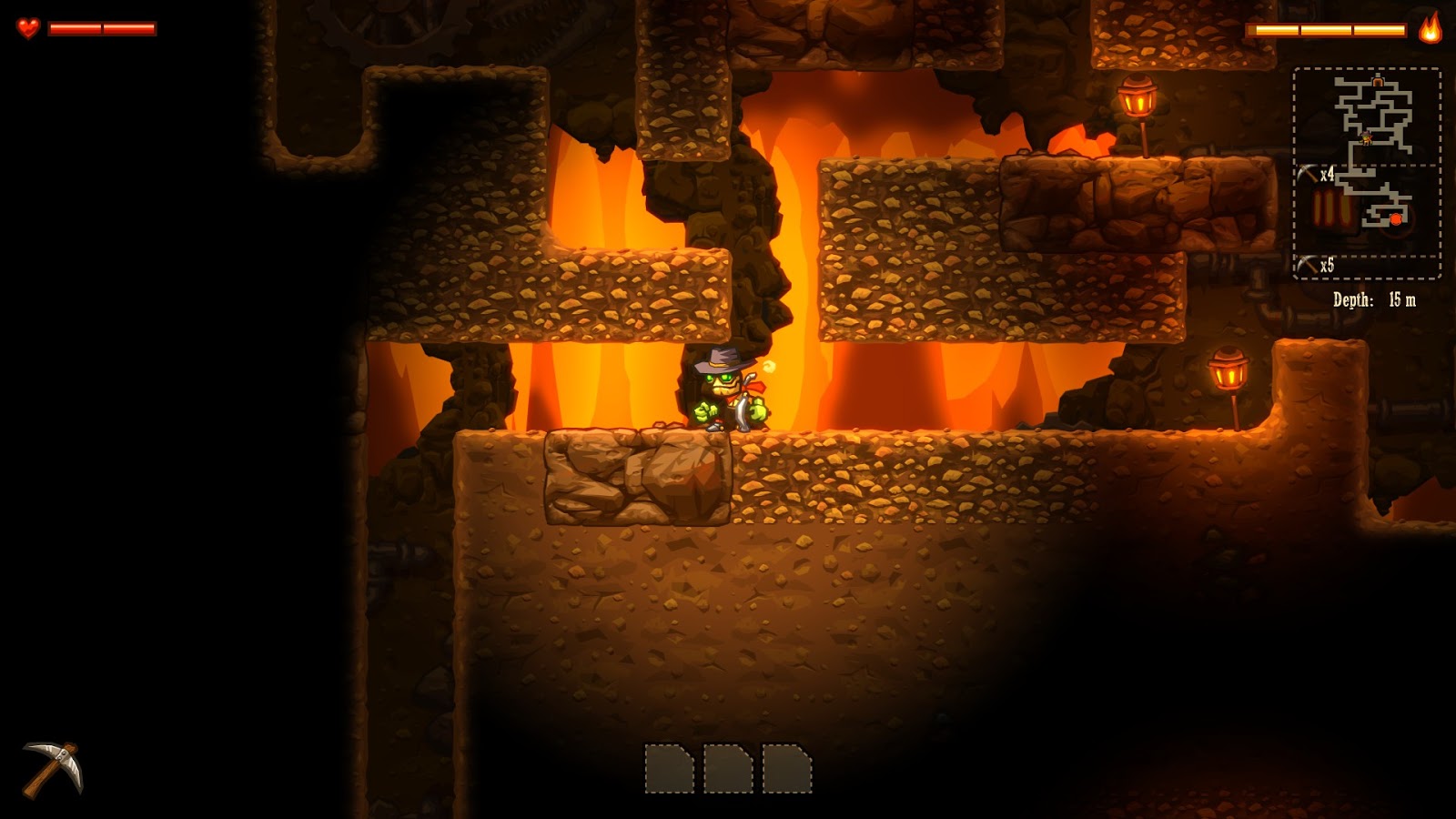
Steamworld Dig is presented in the reviews that pop up when you look over the game news as a Metroidvania, which I don't think it is. In turn, I'm not exactly sure what Steamworld Dig actually is, beyond feeling like the partial combination of various other elements from other games.

First things first, the game's visuals are fantastic, the usual steampunk aesthetic getting its groove on with a mix of other styles. All the characters look good, and the game is just plain easy on the eyes. It feels a lot like playing Terraria, but it is more hand-drawn and in most ways better looking. It doesn't do quite as well in terms of how it uses its lighting, which is a bit disappointing since digging games really benefit from deep shadows and contrast. The lighting effects in Steamworld Dig are rather limited, and don't have the spooky impact they do in Terraria, which was sort of weird.

Second, it is mostly a platformer with digging options - it does have some Metroidvania elements to it, but it doesn't quite feel like one. At its very core, the combat is pretty light stuff, and most of the game is just exploring the mysteries as you dig down in a huge mine and then just keep going with little in the way of backtracking. You do get upgrades along the way, but they generally feel less like something you absolutely need and more like quality of life improvements. There's a good vibe to it, though, just as a certain element starts to drone on in your brain the game throws you an upgrade to make that get less annoying.

In this the gameplay is very satisfying and very soothing. It isn't a difficult game, more or less a casual title, centered on digging. You dig things up, sell them, buy and find upgrades. The game's story is actually very reminiscent of Primordia, which is weirdly ironic given I settled into playing both so close together. It's not exactly as dark as Primordia, but it has many of the same angles that do tend to feel a little grim.

The main elements of the gameplay are digging and then the interaction between digging and your various supplies. You have limited bag space, limited hitting power, limited health, light and water. All of these being depleted makes it pretty difficult to get around, and in the case of health, ultimately kills you. You can upgrade all of this stuff with money or "power orbs" which increases them in a pretty linear fashion over the course of the game. The Metroidvania, I guess, comes from the aforementioned upgrades which grant you running or double jump or the various sort of things you usually gets.

Steamworld Dig is pretty by the book, mixing elements from various other titles, but the clean visual style and simple gameplay make it a relaxing if a little monotonous title. I don't really recommend it in the pure sense of a fantastic, engrossing core title to spend your time on, but I do recommend it if you want something to sit in front of the screen with controller in hand for twenty minutes every once in a while.

Not everything needs to be the next big heart stopper. Sometimes it is alright to just be good, right?

Saturday, May 23, 2015

Toward the Verge: Magicians and Looters

Metroidvania is essentially a subgenre of platformer, which in and of itself is an indie darling of a genre. Since indie games are generally speaking more about cheaply re-doing old ideas, you end up with a lot of bargain basement re-iterations of other ideas sort of gelled together into a quivering mass.

Yes, of course, gaming in general works a great deal like that and it's going to be hard to pick up any game off the shelf that doesn't build off old ideas. But indie gaming is just "geez" sometimes. The weirdest thing is that the re-iteration is based on perceptions about what things were without really studying why and how they were, so you end up with games like this one, where it says its a metroidvania but it's actually more of a platformer that fails at being a metroid and then I don't care about the vania part.

Platformer slash Simon's Quest? Yes. Deal. There you go.

I got Magicians and Looters, as an aside, from one of the earliest Groupees greenlight bundles. I picked it out because I want to play through Metroidvanias, which as an aside has not thusfar been pleasant. It turns out that if you play games like Super Metroid after Super Metroid, games are worse than Super Metroid at everything.

The game stars Brent, a swordsman with no personality other than snide, his sister Vienna with no personality other than snide and Nyn another swordsman with no personality other than snide.

At the start of the game you play Nyn, who is a swordsman of using two swords or I dunno something with pointy bits in her both hands, but then the game gives you the option to continue playing Nyn or to try the other characters. Shortly after, there's a thing, and your party of girls and a guy are off elsewhere, divided up. There's your special hook! Or something. I forget what I'm talking about.


Thursday, May 7, 2015

Toward the Verge: Super Metroid

I am hyped for Axiom Verge.

I am going to wait til the summer sale to pick it up, even if it's not on sale, since I have like $50 in cards to sell and they go faster during the sale. But I am hyped for it, or at least what passes for hype for me, and since it's a "loving homage" to Metroid, I thought I'd go play some Metroidvanias to refresh myself on the very concept. I googled a list and I've scribbled down a couple I'll need to emulate and one I own but completely forgot to play through. Derp. I might give La Mulana a try, but somehow that game never really grabbed me.

First up: Super Metroid, and a brief discussion of this god damn classic that everyone should try at least once in their life. To be honest, I played through the original Metroid as a child and fairly recently on a DS or GBA or whatever one of the Nintendo portable consoles, so I don't really want to give it a replay. The interesting thing is that I was always anxious about replaying the super version, not because it would live up to my nostalgic memories (spoilers: it does) but because of two things: Wall jump and charged jump. Argh! This is so tricky! Push the button then unpush the button before you push the other button?? how do i...

The original Metroid is nowhere near as difficult as people imply it is - you basically just need to take time to figure out enemy patterns and refill your E-tanks as you go. Interesting to note that the game does have, in a roundabout way, the whole avatar strength thing that later gaming is so latched onto. If you spend more time hunting for secrets, you will find more E-tanks and missile pods to have an easier time of the later fights. For a NES game, much like Castlevania, it's really neat looking game. It is very early in the NES' lifespan but I like the almost surreal, strange pixel artwork and how it influenced them to make such weird looking designs.

I mean, look at this cropped shot of a chunk of the map. Lots of different colors, bizarre looking blocks and aliens, the whole of it just immensely strange. When you go for photorealism, you don't get that.