Usual caveats and ranking and caveats to ranking apply. All of this is subjective, these are my reviews, if you think as I do you'll agree. But you don't, so here's how the system generally breaks down;
A - A game I would recommend to people who don't like a genre, something good enough for people generally against it to try. These are the games I think you should definitely look into. This isn't a ranking like "10/10" or "four and a half stars, delivered pizza to my house, performed sexual favors and then changed the oil on my car", this is evaluating games subjectively, from my perspective, who I'd recommend them to. Which is the point of reviewing, to me, anyway.
And these are the games where I'd say "More than the usual". Mind you, I don't mean you should move hard outside you genre just to force yourself to try them. If you hate shooters, it's unlikely an A-rank game is going to redefine how you look at them. Look for them on sale and the like. These are games in X genre that appeal to people who don't usually like X genre.
B - Being games are excellent examples of their genre, but don't stand outside their genre. You have to be interested, at least a little, in playing this sort of game. They have to be your jam. That's not to say a B rank game is necessarily more or less fun than an A rank game, as frankly, I had the most fun with a B rank game this year. This is more that it tends to be a little more bogged down in genre conventions and you need to be keen on how it works.
C - Games that you need to want to play the genre to want to play. Essentially, if B rank games are games where if you like ARPGs you'll like them, C rank games are ones where you need to be in the mood for the genre to like them. If you're not feeling it, well, you probably won't feel it.
D - Games I feel personally won't appeal to most people even within those that like the genre. That's not to say D rank games are all unplayable, or even that they're all garbage. Just that I'm not sure even if you were in the mood you'd be up for these.
E - Games I never finish reviewing, so they don't go on this list. There's about 10-20 games a year that fall into this category.
Also, this is a listing of games I reviewed this year, very few of which are ever actually from a given year. This is a guide to going through Steam sales and picking out stuff you might have missed at a low price, not a guide to the latest and greatest. I'm not even suggesting you buy these games this year.
I generally tend to lean toward lowering the ranking of games that are more difficult. As I said, this is about recommending games, and "difficult" is something of a subgenre. I've never met a "tuned to be difficult game" I would actually say I would recommend to anyone to pick up and try. There's lots of good ones, but the harder you tune a game, the less people who can play it and enjoy it.
The Gap: There's a four month gap in my reviews this year, which often happens around March, but went kinda wild this time. Basically, I played Serious Sam 3 - which I hated - Arkelash Legacy - which was disappointing - and spent like fifty hours dicking around with Skyrim but never actually finished it. Also Phantasy Star 2, which I think I eventually reviewed but who cares.
Showing posts with label neonfuture. Show all posts
Showing posts with label neonfuture. Show all posts
Sunday, January 1, 2017

Thursday, November 17, 2016
Inaccurately named: Gunpoint

Your character is holding a gun on the box so... Actually I guess it's kind of a reverse spoiler or something... Well, whatever. Gunpoint is a puzzle game, a genre rarely recognized for its thrilling action-o-matic scenes. Actually it might be better described as a Noir detective ninja puzzle game, or maybe a spy thriller puzzle game. You're described as a spy, but you look more like a noir era detective. It's a spy game, basically, in that fantasy realm of spy games that I don't think we get that many of any more.
Well, there isn't a box. If there was a box, then he'd be holding a gun on the box. Or the tin, if you bought the hypothetical nonexistent collector's edition.

It's also a pixel art game. If you've been reading my reviews for a while, you probably realize I'm a little enamored with pixel art games. Good pixel art, mind you, which can be minimalist like Risk of Rain or incredibly detailed like Sonic Mania. There's lots of bad pixel art, lots and lots, people just taking the easy way out and making something "retro".
I wouldn't describe Gunpoint as retro. In fact, the juxtaposition of elements and ideas in Gunpoint are such that it really ends up defining itself by stringing together those elements into something that feels familiar but also unique.
Sunday, October 30, 2016
Retro reviews: Phantasy Star II
 Phantasy Star 2 was released in the odd period between the NES and SNES, where it felt like developers really weren't tapping the power of the Genesis at all. The original Final Fantasy is its immediate FF neighbor in the West, and while Phantasy Star 2 is visually more enticing than that, it is so much worse looking than FFIV. It's funny how these games are divided by years, but as a teenager, it never really connected how big the gaps in development were. Graphical quality was increasing in huge jumps, as both the technical development improved and the sprite art improved as well.
Actually it's kinda funny how people in the modern day have zero concept of the gaps between game releases. I read some complaint about how Alex Kidd in the Enchanted Castle (which is bad, don't get me wrong) made a guy "thankful" he had a SNES as a child. Alex Kidd predates the SNES by like, a year or something. You weren't playing Alex Kidd when the SNES was available, unless you rented it, at which point you were renting an old goofy Genesis game.
 In spite of the fact I owned a Sega Genesis - a generation 1 model, in fact, bought almost on the day of release in North America- I never finished PS2. The game was rather unpleasant in terms of difficulty curve, as it never really became super obvious as a small child that 90% of RPG difficulty
could be mitigated with grinding and just drawing maps. The game is already far enough back that my only memory is getting the first new party member, and how awesome the box art is. It also seems to have nothing to do with anything, but hey, whatever. That art owns.
I really miss the era of non-anime box art for western releases of Japanese games. It went away sooner than later, but that is some trippy shit instead of the cool but kinda plain Japanese release art. Stuff like this dying out reminds me why I hate weebs.
RPGs on the SNES and Genesis were more expensive than their less memory equipped cartridge compatriots, owing to the necessity of adding additional physical media within their plastic prisons - the so-called 'battery backup' that actually really was. (I've read some games, however, had flash memory instead) As such, PS2 - and many of its ilk - weren't games my friends and I bought when I was young enough that this game was new, but rented. It's such a weird thing, remember how you'd basically "borrow" these games from a store and you'd often be praying weekend to weekend - or weeks apart - that someone didn't send your saved game off to oblivion.
Monday, September 12, 2016
Summer of Sonic: Wrap-Up
Tables of Contents for the Summer of Sonic;
 |
| Sonic the Hedgehog |
 |
| Sonic 2 |
 |
| Sonic 3 & Knuckles |
 |
| Sonic CD |
 |
| Sonic 4 E1 |
 |
| Sonic Heroes |
 |
| Sonic Adventure 2 |
 |
| Sonic ATS |
 |
| Sonic Lost World |
 |
| Sonic 4 E2 |
 |
| Sonic Generations |
 |
| Unleashed + Dolphin Colors |
Wednesday, January 27, 2016
Eight long rolling weeks; SRR: Dragonfall

Choices matter. They matter because you make a choice, and then, that's what you did. Deep. Deep like the rolling pin games, on the computer.
Dragonfall is the follow up to Shadowrun Returns, which contained the campaign "Deadman's Switch" or some variation on that string of letters. A lot of people seemed pretty down on DMS, but I thought it was a pretty effective tutorial, which I've said about 75 times or something in the last year. Dragonfall inversely is meant to be more of a standalone adventure more suited to experienced players.
On a basic level this is a RPG with squad based tactical combat set in a cyberpunk world. Dragonfall (as a game) comes off as a fair bit more toward the dystopian than DMS, but not really to the point it feels like the setting isn't being used - more like the setting has more depth to it than the usual RPG nonsense, and different parts of the world feel different. Which is a good thing.
I don't, and I know I've said this, feel much of anything special toward Shadowrun. As earlier RPG systems go, I never really played anything other than D&D. I don't even like D&D though, the only systems I have much of a soft spot for are the White wolf nonsense which is endearing in its completely ridiculous nature and BattleTech which just has the best world-building coupled with a legacy of endless failure. Shadowrun is just "there" for me, it is built out of disparate cyberpunk parts but doesn't really hum with its own energy. So while I think these games are cool, I'm not saying that out of nostalgia.
I kinda like or dislike this game on its own merits, even disregarding it as a sequel, since I barely remember DMS other than how good the story hook was.
Thursday, December 31, 2015
Toward the Verge: Strider

Strider is a word used here for ... Like literally ninja. You're a "strider" from a "strider" school which teaches you to strider people to death. It's weird. They also call you "Strider" like it's a name but you are also a strider from that strider school, and they previously sent other striders to bestride the stride-able but they failed in their striding leaving all possible stridering to you.
Or something? In Ninja Gaiden do they just call the main character 'ninja?'
I had actually played Strider on the Genesis slash Mega Drive back when I was a young'un, but I don't have any strong memories of it. Reading wikipedia on the history of the release, it sounds like it was considered very highly as games go and not a metroidvania at all. Strider, here, is a Metroidvania and thereby covered vaguely under the toward the verge sub-banner of games I've played.
I'm going to be honest in that as a genre goes or has gone for me this year, this has not been what I would call a pleasant set of games. Generally speaking what you end up with are a lot of games with dull hallways, mediocre enemy placement, boring gameplay. No sense of exploration, of 'opening up' the game world or progression.
Strider is both the best and worst of the games I played in this regard. I didn't write many reviews, since there are more than a few games I feel like I might go back to in the doldrums between the two great sales, when I'm not trying to grind out many a card. Strider is a mix of a lot of elements that really make me wonder how much better it would have been if it wasn't crippled by being lashed to metroidvania elements.
It is also apparently inspired by Shadow Complex, so man, did that ever make me not want to pick up Shadow Complex.

The coolest thing about this game is that the Strider's scarf changes color when you change plasma options. You won't notice this early on, since you don't get a plasma change for quite a while, but you can actually change it on the fly and it slowly flows out. A lot of the visuals pick up on this sort of subtle element while the rest of the game hesitantly sits down before drooling on itself.
Thursday, October 15, 2015
The Dork Quadrant: Death Ray Manta

 Games keep piling up, regardless of how fast I finish them or mark them undesirable in my ever bloating steam games list. I haven't quite topped a thousand, yet, but it is only a matter of time. In an effort to pick through a couple more games this month, I decided to set up a grouping of games - forgetting I'm supposed to play scary games this month, derp - with the intent of mining them for cards. And then forgetting to actually pick games with cards.
First up in this series of four space shooty ship games is the surreal neonfuture experience of Death Ray Manta, which is ... Perhaps one of the simplest games I've ever played, but also an excellent model for what a lot of games do not successfully do.
 DRM is basically an extremely stripped down, colorful twin stick shooter. And I do mean colorful. You will be full of colors watching it. You move with one stick, shoot with the other, and as best I can tell gameplay does not really change on your end at any point. You accomplish three goals - not dying, shooting all the enemies you're supposed to, and picking up gems - and you finish each level when all the enemies are dead. The game flashes a lot of words and colors at you while jazzy music plays, but because it is so simple, you don't really get distracted.
The game is ... That's it. That's the entire game. What makes the experience good, besides the hyper trippy visuals and solid music, is that it does everything with a sense of brisk. It loads quickly, it runs quickly and it makes no comment about your beginning or ending. It isn't concerned with that you died or with making snarky passive-aggressive remarks. It just throws you back into the action, and it is easy to get in the groove and played for a couple minutes with a smile on your face.
A lot of games get this wrong. Loading times are always going to be an issue, of course, but DRM also just doesn't wander from the point. The story is that the manta has lasers in his head, so he blew up his house and lives in space instead.
Problem is, the game is just too simple and the difficulty is pretty flat. You die in one hit, and although the game doesn't move that fast, the screen is utterly swarmed with nonsense in no time flat. So you're going to die, often and a lot. It doesn't mean anything to you, and you just go again, but the problem does seep in - there's one track, and there's one track through the levels.
 I don't think adding a lot of complexity would aid the game overmuch, but I do think it could do with perhaps a different path through the levels determined by some element you don't recognize quickly and then maybe another music track or two. The game repeats through cycles rapidly, and while it is fun in little chunks, there isn't enough to keep it from getting repetitive.
I let my sister - who is definitely more of a casual gamer - give DRM a try. Unsurprisingly, she found it really enjoyable, and claimed it was "the game they would have made in the 80s, if they could have". So for a casual gamer, I think it's a fun little trip, and for me it was a decent enough aside.
Saturday, September 19, 2015
Pac-Man Championship Edition DX+

At least: As far as I can remember. Pac-Man is one of the 'forgotten' gaming icons, unless your name is Adam Sandler, something that didn't really hold on through the years, though more so than like ... Bubsy the cat. I honestly don't know that I played the original Pac-Man or any revision in the past, so this is a review of this game without really knowing what tier of update it is. I'm just going to shorten the title to Pac-Man, I'm not referencing any other game or version of this game. That's it, here we go, ghosts on the chomp
Gaming revivalism is an interesting concept to me, since you end up with a lot of weird phrases and ideas mixing with what ultimately amounts to marketing via the hook of nostalgia in your soft unprotected rump. Franchises at this point sort of co-exist in a market space dominated by franchises, and names don't really have a meaning beyond being "okay" for mainstream play. Pac-Man probably doesn't have the star power of say, a Ubisoft or Nintendo mass-produced product, and as such, isn't exactly a revival so much as just a game based on Pac-Man.
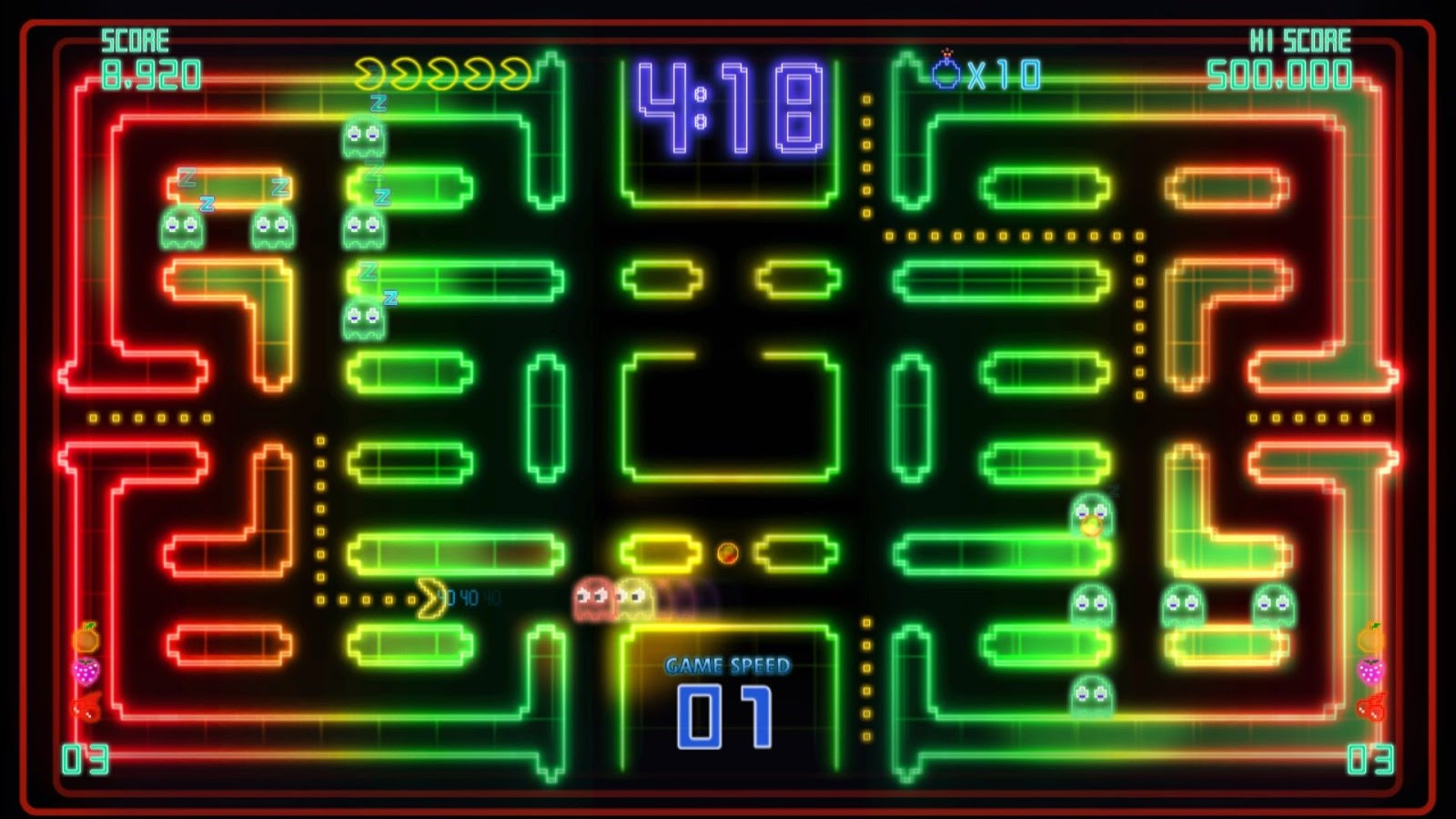
As you can tell, I don't know very much about Pac-Man and wasn't especially hyped about Pac-Man.
Subscribe to:
Posts (Atom)